Learn More

Glossary

Decklo Terms

Artist
The person who physically creates the art that consists of or is contained in the final product.

Producer
The person or company that oversees the project of creating a product. The coordinator of all elements (artists, printers, logistics, funding, etc.) in order to bring a project to market.

Product Name (Series Name)
The title or name of the product.

Manufacturer/Printer
The name of the company that physically prints the final product created by the Artists and coordinated by the Producer.

Edition
The Edition differentiates editions of a Product (Series Name). Example: V1, V2, V3, Red, White, Blue, Collector (edition), Artist Proof, etc.

Brand
The Brand or Brand Name, in this context, is used to differentiate the Producer and Brand IF NEEDED. If the producer is the owner of the Brand, then this does not need to be filled out. Example: Bicycle is a Brand of USPCC but any Producer can work with USPCC to create a Bicycle Brand deck so not all Bicycle Brand decks are produced by USPCC.

Release Year
The year the product was openly sold to the public.

Card Construction
These are elements that are physically present in a product and generally have no bearing on value. Examples: Landscape oriented, 4-Pip, custom indices(numbers), jumbo index

Card Embellishments
These are elements added, at additional cost, to a product in order to raise the complexity and or value of a product. Examples: Die-cut, Foil, UV Spot Ink, etc.

Box Construction
These are elements that are physically present in a product and generally have no bearing on value. Examples: Tin container, 2 deck box, Plastic Box, Reveal back, etc.

Box Embellishments
These are elements added, at additional cost, to a product in order to raise the complexity and or value of a product. Examples: Flocked, Interior Printing, Emboss/Deboss, Windowed, etc.

Card Genre

Advertising
A product that is made for a specific company ex. Coca-Cola

Bridge
A product designed for a specific game

Cardistry
A product designed specifically for cardistry

Casino
A product that is made for a specific casino

Euchre
A product designed for a specific game

European
A product that is made for a specifically based on European design style

Magic
A product designed specifically for magic or having magic elements

Minimalistic
A product typically having very few design elements.

Mixed Back Deck
or Variegated Back Deck is a deck of cards where all the backs are different.   These decks are designed to have unique back designs for each card, which can enhance visual appeal and add an element of surprise in card games or magic tricks.

Mixed Face Deck
or Variegated Face Deck is a deck of cards where all the Faces are different.   These decks are designed to have unique back designs for each card, which can enhance visual appeal and add an element of surprise in card games or magic tricks.

Novelty
a type of custom deck that features original or unusual designs, often with unique artwork for the court cards and stylized pips. These decks are typically created for fun or artistic purposes rather than traditional gameplay.

Pinochle
A product designed for a specific game

Poker
A product designed for a specific game

Reproduction
A product that is a perfect recreation of an older product. Generally only made when the original product is incredibly rare.

Semi-Transformation
a type of playing card deck where the traditional pips (the suit symbols) are incorporated into a larger, artistic design, but they may not be in their standard positions, sizes, or colors.

Souvenir
A product that is made for a specific destination. Ex. Ireland, California

Tarot
A product designed for a specific game

Transformation
a type of playing card deck where the traditional suit symbols (pips) are creatively integrated into a larger artistic image while maintaining their standard positions.

Magic Components

Blank Face
This deck contains cards with blank faces, which can be used for various effects, such as revealing a previously blank card with a chosen design or signature.

Brainwave
Similar to the Invisible Deck, but the back design of the chosen card matches the rest of the deck, even though the faces are all different. 

Double Blank
These decks are examples of decks with unusual backs or faces that can be used for specific effects.

Double Faced
These decks are examples of decks with unusual backs or faces that can be used for specific effects.

Double Backed
These decks are examples of decks with unusual backs or faces that can be used for specific effects.

Gimmick/Gaff
A deck of playing cards that contains specially printed or altered cards, known as “gaff cards,” designed to facilitate or enhance magic tricks

One-Way Forcing Decks
These decks are designed to make a specific card appear to be chosen by the spectator.

Invisible
This deck allows a spectator to think of a card, and the magician can reveal it as the only card face down in the deck, or have it be the only one facing the opposite direction. 

Marked
A standard deck with subtle markings on the backs of the cards, allowing the magician to identify the value and suit of any card. 

Mirage Deck
Custom designed for visual magic tricks, often used for producing, vanishing or transforming objects.

Mnemonica Stacked
a specific order of a memorized deck of cards created by magician Juan Tamariz, which is widely used in card magic. It allows magicians to perform tricks by recalling the position of each card in the stack.

Rising Card Deck
Also called a Haunted Deck. A deck where one or more cards can rise or be pushed out of the deck on command.

Stripper
Also known as a tapered deck. The cards have a slight taper, allowing the magician to easily locate or strip out specific cards.

Stacked

Svengali
Consists of alternating short and long cards, enabling various effects like forcing a card or making all cards appear identical. 

Card Back Style

Animation
Flip book animation or some form of movement shown as the backs are fanned thru.

Bordered
Typically having a solid border around the edge of the cards

Borderless (Full Bleed)
Typically having printing extend all the way to the edges of the card

Broken Bordered
Typically having a border but some printing extends to the edges of the card

Minimalistic
Typically having very few design elements.

Mixed Back Deck
Also known as Variegated Back Deck is a deck of cards where all the backs are different. These decks are designed to have unique back designs for each card, which can enhance visual appeal and add an element of surprise in card games or magic tricks.

One-Way
Where the design is not symmetrical.

Puzzle/Picture
The card backs lay together to create a connected image.

Stinger
Where the card fades out into the border.

Two-Way
Where the image is designed to be recognizable regardless of whether the card is held right-side up or upside down.

Courts

Arrco

100% Custom
Fully customized court cards.

Faro
The specific designs used for the King, Queen, and Jack in the game of Faro, a popular 18th and 19th-century gambling game.

Modified
Standard courts with modified faces or other small changes.

One-Way
Face cards (King, Queen, Jack) where the design is not symmetrical, meaning it has a distinct top and bottom.

Two-Way
Refer to court cards (King, Queen, Jack) where the image is designed to be recognizable regardless of whether the card is held right-side up or upside down.

Seal

1 Pack
An IRS tax Stamp designated for “1 Pack”.

50 cents
An IRS tax Stamp designated for “50 cents”.

Arrco
Standard Arrco Suits

Custom
A completely custom and unique seal created for a single project and is not a standardized style for the producer.

D&D
Dan & Dave – Typically Black, Blue, Gold, Red or White

EPCC
Typically Black, Blue

Faux Seal
A Faux stamp or seal printed directly on the product package.

Foil
A seal that has foil elements

Hoyle Seal Variants
USA Guaranteed, USA Ohio, USA St Paul MN

Hoyle Standard square Hoyle seal.
Hoyle Half Size Narrow Hoyle seal

MPC (Make Playing Cards)
Company specific seal.

Ohio
Early USPCC Ohio Seal

Oval
Oval in shape

Paper
Seal made from paper as opposed to a modern sticker of some sort.

Perforated
Perforated across the box line to make breaking the seal easier.

Private Die Stamp
Type of revenue stamp used in the United States during the 19th and early 20th centuries. Unlike standard government-issued revenue stamps, private die stamps were custom-designed for individual companies, usually in industries like playing cards, tobacco, liquor, matches, and patent medicines.

Producer Seal
Seal that uses the name or logo of the producer of the product. Think of a USPCC seal but it’s branded Aarco, Oath, Stockholm17, Kings Wild etc

Ribbon
Long, narrow seal

Round
Round or circle shaped

Stamp
Perforated Edges like a Postage Stamp

Tax Stamp
Official Government Taxation Stamp

USPCC
The U.S. Playing Card Co seal, typically Black, Blue, Gold, Red or White

USPCC Stamp Blue Seal
These labels were used after tax stamps were no longer required by the IRS so USPCC used the overrun of blank perforated labels from 1965 thru 1976.

USPCC Sticker Blue Seal
Circa 1977 USPCC shifted to stickers when they ran out of the perforated tax stamps

Box Construction:

Accordion
Pulls open from both sides like an accordion

Box Set
Generally 2 or more decks of a set, being in an ornate style box

Blister Pack
Typically a plastic security package with a Blister or bubble for the product it contains

Clamshell
Typically a plastic hinged lid security package

Fan-Open
Box opens like a fan

Flask
The age old screw top flat portable beverage container

Flip-Top
Cigarette box, also known as a hinge-lid

Glassine
Waxed Paper – Mainly used in the Mid-1800s before boxes were being made.

Hang Box
A box with a hang tag hole or loop

Magnetic
Magnetic closure typically seen on gift boxes

Matte
Matte paper stock

Metal
Box constructed of metal.

Multi-Piece
More than 2 piece construction

No Box
The product was originally sold without a box

No Cello
The product was originally sold in a box but was not wrapped in cello

Plastic
Box constructed of plastic.

Reveal
Card back is shown on the back of the box

Shelled
Has an exterior and interior box

Side-Open
A box that opens along the long edge as opposed to the typical short side

Sleeved/Banded
Has an extra sleeve around the box

Slide
Match Box style box

Slipcase
Five-sided, drawer style box

Standard Tuck
Typical tuck box as seen with most playing cards

Tin
Typically a hinged lid, thin metal container

Two Deck
A box that holds 2 decks of cards

Two-Piece
Two-part box, typically a base and lid.

Wood
Box constructed of Wood.

Card and Box Embellishments

Die-cut
This represents any shape cut out of the box. Although ‘Die-cut’ is specifically a stamp punch process.

Emboss/Deboss
To mold, or stamp a design on (a surface or object) so that it stands out or is depressed in relief

Flip-book
Flip-book Animation

Flocked
Velvet/Felt layer on box

Foil
Hot foil and cold foil are two different techniques used in foil printing to create a shiny, metallic effect on various materials. Hot foil stamping uses heat and pressure to transfer a thin layer of foil onto a substrate, while cold foil printing applies a liquid adhesive to the substrate and then transfers the foil using pressure and UV curing.

Interior Printing
Printing on the interior of the product box.

Interior Foil
Foil used on the interior of the product box.

LED
A box with integrated LED lighting.

Lenticular
A visual illusion achieved through specialized printing techniques, creating the appearance of depth, motion, or changing images when viewed from different angles

Letterpress
A form of relief printing, where ink is applied to raised surfaces and then pressed onto paper, creating a tactile impression.

Metallic Ink
Close to foil but ink has a more subtle sheen than foil.

Optically Variable Ink (OVI)
Color changing counterfeit bill ink

Pearlescent
Provides a subtle, shimmering sheen, creating a captivating visual effect as the cards catch the light. This finish, often achieved through a special coating or incorporation of pearl-like pigments, gives the cards a unique elegance and a distinct look compared to standard finishes.

Photochromic Ink
A type of ink that changes color when exposed to ultraviolet (UV) light, such as sunlight

Scented
A product that has a scent (like vanilla) added to it.

UV Ink
A specialized ink that cures or dries almost instantly when exposed to ultraviolet (UV) light

UV Reactive
Exhibits a change in appearance, typically visible light emission (fluorescence), when exposed to ultraviolet (UV) light

UV Varnish
A clear liquid coating applied to printed materials and then cured using ultraviolet (UV) light

Windowed
A square/rectangular die-cut window

Windowed W/Cello
A square/rectangular die-cut window with cellophane applied

Card Construction

100% Custom
Custom designed pips and Numbers (Indices)

4-Pip (European Index, Quad-Pip)
Each face has numbers and pips in all 4 corners

Custom Pips
Custom pips on playing cards refer to variations in the standard suit symbols (hearts, diamonds, clubs, spades) and their arrangement on the cards. These variations can include different designs, colors, or even incorporate the pips into larger artistic images. They are a popular way to personalize or add unique artistic flair to a deck of playing cards.

Custom Indices
Custom designed numbers or index in the Corners of the faces.

Dexter Indices
Refers to a style of corner indices where the card designation is inside the pip.

Face-Down Cut (Traditional)
refers to a cutting method where the cards are cut from face to back, resulting in a sharp edge on the back and a rounded edge on the face. This technique is preferred for its superior handling characteristics, especially for shuffling and card tricks.

Face-Up Cut (Modern)
refers to a method of cutting playing cards where the cards are cut from back to face. This process is more efficient for manufacturing but may require a break-in period for optimal performance compared to traditionally cut cards, which are cut from face to back.

Four Color Suits
When each suit has a different color.

Emboss/Deboss
To mold, or stamp a design on (a surface or object) so that it stands out or is depressed in relief.

Landscape Orientation
When a product is legible when viewed from the long edge.

Large/Jumbo Index
Larger than average corner numbers and pips.

Minimalistic
Typically having very few design elements.

No Index
May or may not have pips but do not have numbers.

One-Way
A card where the design is not symmetrical, meaning it has a distinct top and bottom.

Semi-Transformation
A type of playing card deck where the traditional pips (the suit symbols) are incorporated into a larger, artistic design, but they may not be in their standard positions, sizes, or colors.

Short
A standard deck where some cards have been removed, typically the low cards (2-5).

Transformation
A type of playing card deck where the traditional suit symbols (pips) are creatively integrated into a larger artistic image on each card.

Triplicate Indices
Refer to a design innovation where miniature representations of the card appear in the upper left and lower right corners.
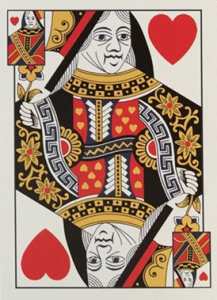
Two-Way
Involves inverting the top half of the image and placing it on the bottom, creating a symmetrical design that is readable whichever way the card is held.

Card Sizes

We’ve constructed an exhaustive list of card sizes and discovered somethings along the way.  For instance, a ‘slice’ is a deck that is full height & half wide, 1.25×3.5in deck.

These 7 are the most used in the industry. After these, they are sorted by size
Standard 2.5 x 3.5in (63 x 88.9mm)
Bridge 2.25 x 3.5 (57 x 88.9mm)
Mini 1.75 x 2.5in (44.5 x 63.5mm)
Tarot 2.75 x 4.75in (70 x 120mm)
Uncut Sheet
Uncut Tuck Box
Custom Die Cut Shape

Listed in order of size of width:
.812 x 1.37in (22 x 34.8mm)
Micro 1.25 x 1.75in (32 x 45mm)
Slice 1.25 x 3.5 in (31 x 88.9mm)
Hanafuda 1.25 x 2.12in (32 x 54mm)
1.5 x 5 (38.1 x 127mm)
1.45 x 2.24in (37 x 57mm)
Patience 1.65 x 2.48in (42 x 63mm)
Tarot Pocket 1.73 x 3.14in (44 x 80mm)
1.73 x 2.99in (44 x 76mm)
Jumbo 1.73 x 3.14in (44 x 80mm)
Tarot Mini 1.75 x 2.875in (44 x 73mm)
1.75 x 2.875in (44.5 x 73mm)
Domino 1.75 x 3.5″ (44 x 89mm)
Magnin 2 x 3.5in  (50.8 x 88.9mm)
Italian 2 x 3.29in (51 x 83.5mm)
2 x 3.18in (51 x 81mm)
Italian Slim 2 x 4in (51 x 103mm)
2.05 x 3.27in (52 x 83mm)
2 x 3.54in (52 x 90mm)
2.16 x 3.38in (55 x 86mm)
2.24 x 3.74in (57 x 95mm)
Skat Romme 2.32 x 3.58in (58.9 x 90.9mm)
2.36 x 3.74in (60 x 95mm)
Spanish 2.4 x 3.7in (62 x 95mm)
Tarot French 2.4 x 4.4in (60 x 112mm)
Trump 2.45 x 3.95in (62 x 100mm)
Pinochle 2.48 x 3.46in (63 x 88mm)
German 2.48 x 3.93in (56-63 x 100mm)
Square 2.5in (63.5mm)
2.51 x 3.62in (64 x 92mm)
2.75 x 3.75in (69.85 x 95.25mm)
2.75 x 4in (69.85 x 101.6mm)
2.75 x 4.18in (69.85 x 106.17)
Tarot Thoth 2.75 x 4.37in (70 x 111mm)
Tarot 2.75 x 4.75in (70 x 120mm)
Square 3in (76.2mm)
Parlour 3 x 4in (76.2 x 101.6mm)
3.12 x 4.5in (79.2 x 114.3mm)
Round 3.5in (89mm)
3.5 x 4.75 (88.9 x 120mm)
Index 3.5 x 5in (88.9 x 127mm)
Tarot Oracle 3.5 x 5in (88.9 x 127mm)
Large 3.5 x 5.75in (88.9 x 146mm)
Tarot Large 3.5 x 5.75in (88.9 x 146mm)
Tarot Giant 4 x 6.5in (102 x 165mm)
Flash 4.1 x 5.8in (105 x 148.5mm)
4.5 x 7in (114.3 x 177.8mm)
4.75 x 7in (120 x 177.8mm)
5 x 7in (127 x 177.8mm)
8 x 10in (203.2 x 254mm)


Stay up-to-date

Sign Up for the Decklopedia Newsletter